
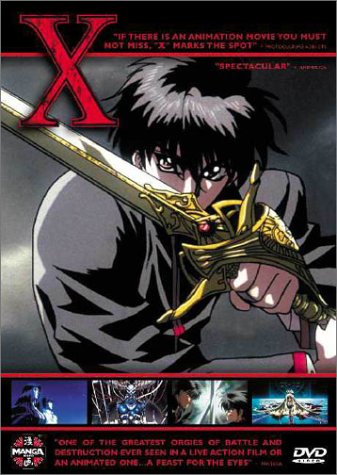
Full of dreams and flashbacks that pop up out of nowhere, the structure of X could be considered confusing and needlessly complex--if the story weren't so simple. Obviously, we're supposed to root for the Dragon of Heaven to win and save mankind, but the funny thing is, the Dragon of Earth has the better argument. If it were a debate, humanity would lose. But it's not a debate, it's an action film, and many of Tokyo's most famous buildings get destroyed in the battles. As with most anime, the women are either girlishly cute or slutty, but luckily in X, there are no graphic rapes; the love interest is merely crucified three or four times. It may not be the greatest anime film out there, but at least it's never boring. --Andy Spletzer
I have several of the graphic paperbacks from the X/1999 clamp production. I've read and puzzled over those, and now I have spent several hours with this DVD. There comes a point in the quest for value where one has to finally ponder why a work is the way it is. I don't expect every DVD or book to be a work of art, but I do expect that each such effort have some sense of its purpose or potential value.
In the case of 'X', I confess I am mystified. On the surface, a young man (Kamui) returns to Tokyo at the behest of his dying mother to defend those he loves. But he fails to defend Kotori, who loves him, and forces his friend Fuuma to make impossible choices. On the layer below this Kamui and Fuuma are doomed to become the primary antagonists in a struggle over whether the human race should be allowed to survive. In the ensuing fight, shared with the other dragons of heaven and earth, the destruction is sufficient to wonder whether the cure is worse than the disease.
In truth, the plot is a pre-ordained ballet of opposing forces driven to a tragic conclusion. I am not familiar with Japanese literature, but 'X' reminds me of a Greek tragedy where anyone could stop the inevitable end, but no one does. Kamui's tragic flaw is his inability to act until it is too late. Fuuma, supposedly the villain of the piece, seems to be the nobler of the two, simply because he throws himself into his role. All of the characters are disjointed archetypes, but despite all of the symbols and portents, nothing really gels.
So this becomes an apocalypse in search of a cause. Harumitsu Shimuzu as put together an excellent score, which seems to capture Kamui's perpetual agonizing and the film's ambivalent perfectly. The film's theme, 'Forever Love' by Yoshiki, is worth keeping as well. But good music and interesting artwork are not enough to overcome a skeletal plot that never moves in any direction for long. A glance at the final credits reveals that this was a production with a cast of hundreds, and perhaps that is the problem. Tragedy is best when it is not designed by committee.
0 komentar:
Posting Komentar